Free guide
The TMUA explained
The Test of Mathematics for University Admission (TMUA) is a two-paper, multiple-choice mathematics test used by several UK universities to select applicants for Mathematics, Computer Science, Economics and related degrees. This guide covers what it is, who needs it, how it works and when to sit it.
In this section
Guides to the TMUA
Which universities use the TMUA
Every course that requires or recommends the TMUA for 2027 entry, from the official list: Cambridge, Oxford, Imperial, LSE, Warwick, UCL and Durham.
TMUA dates and registration
TMUA dates for 2027 entry: booking closes 28 September 2026, and the test is on 15 or 16 October 2026 or 8 January 2027. Fees, bursaries and results.
How to prepare for the TMUA
General advice on preparing for the TMUA: when to start, which official materials to use, what the test rewards, and how to get the most from practice.
At a glance
- Format
- Two papers of 75 minutes, 20 multiple-choice questions each
- Calculator
- Not allowed
- Score
- One overall score from 1.0 to 9.0
- Where
- On computer, at a Pearson VUE test centre
- Fee
- £78 in the UK and Republic of Ireland; £133 elsewhere
- Next sittings
- 15 or 16 October 2026, or 8 January 2027
What the TMUA is for
Applicants to the most competitive mathematical courses usually have the same top predicted grades, so grades alone can't separate them. The TMUA gives every applicant the same questions under the same conditions, whatever their school system, and tests the kind of mathematical thinking these degrees demand: applying what you know to unfamiliar problems, and reasoning carefully about mathematical arguments.
It is run by UAT-UK, a collaboration between Imperial College London and the University of Cambridge, which also runs the ESAT and TARA.
Who needs to take it
For 2027 entry, the TMUA is used by Cambridge, Oxford, Imperial, LSE, Warwick and UCL, and recommended by Durham for some courses. At some universities it is compulsory; at others it is recommended, and the same university can do both for different courses. The subjects are mainly Mathematics, Computer Science, Economics and related courses such as Data Science and Actuarial Science.
The full list, course by course, is in which universities use the TMUA. Oxford adopted the TMUA for 2027 entry in place of its own MAT; see the MAT to TMUA switch.
The format
| Paper | Time | Questions | What it assesses |
|---|---|---|---|
| Paper 1: Applications of Mathematical Knowledge | 75 minutes | 20, multiple choice | Applying your knowledge of mathematics in new situations |
| Paper 2: Mathematical Reasoning | 75 minutes | 20, multiple choice | Mathematical reasoning and simple ideas from elementary logic |
The test takes two and a half hours in total. It is taken on a computer at a Pearson VUE test centre: you read the questions and choose your answers on screen, and do your working on materials the centre provides. You can't use a calculator or a dictionary.
What it covers
UAT-UK describes the content as that typically covered in higher-level GCSE Mathematics and AS-level Mathematics, and publishes a full specification. Paper 2 also draws on logic and proof: the language of mathematical statements, such as "if", "only if" and "necessary and sufficient", and the ability to judge whether an argument or proof is valid. UAT-UK publishes separate notes on logic and proof for this reason.
The mathematics itself is rarely the hard part. The difficulty comes from unfamiliar questions, the time limit and the absence of a calculator.
How it is scored
- Each question is worth one mark, and your score depends on how many you answer correctly.
- Wrong answers don't lose marks, so it is worth answering every question.
- You receive one overall score on a scale from 1.0 to 9.0, to one decimal place, which allows scores from different sittings to be compared.
- There is no pass mark. Each university decides how to use the score.
Some universities publish information about the scores of their applicants or offer holders. Treat unofficial "good score" figures with caution: they vary by course and year, and many are guesses.
When to sit it
There are two sittings for 2027 entry: 15 or 16 October 2026, and 8 January 2027. Most Oxford and Cambridge applicants must sit in October; some other universities accept January, so check your courses before you book. You can sit the TMUA only once per application cycle. Booking for October closes on 28 September 2026. Every date, and how to register, is in TMUA dates, registration and fees.
How universities use the result
Your score goes automatically to the universities on your UCAS application that use the TMUA, and they consider it alongside the rest of your application. Where the test is compulsory, applying without it can make your application invalid. Where it is recommended, a strong score can support your application. How much weight it carries varies by university and course.
The TMUA and other tests
- ESAT: the equivalent test for engineering and the sciences, run by UAT-UK. It is modular, and its mathematics modules overlap with TMUA content, but it doesn't have the TMUA's logic and proof paper.
- STEP: a much longer, written mathematics exam. Cambridge uses it in its offers for Mathematics, so it is sat in June, after offers are made, rather than to decide who is interviewed.
- MAT: Oxford's former mathematics test, last sat in October 2025 and replaced by the TMUA. See the MAT to TMUA switch.
- TARA: a test of academic reasoning skills that isn't specific to any subject, used by Oxford and UCL for some courses.
Preparing for the TMUA
Good preparation means knowing the content in the specification, getting used to the conditions (no calculator, multiple choice, a strict clock), and taking Paper 2's logic and proof seriously. How to prepare for the TMUA explains where to start and which official materials to use.
Official sources
Dates, requirements and rules on this page come from these official sources, checked on . They change from year to year, so confirm anything you rely on against them. Boxes labelled “Our advice” are Whitehall Academic’s own view.
- UAT-UK: Test of Mathematics for University Admission (opens in a new tab)
- UAT-UK: the ESAT, TMUA and TARA (opens in a new tab)
- UAT-UK: Key dates and deadlines (opens in a new tab)
- UAT-UK: Frequently asked questions (opens in a new tab)
- UAT-UK: Course List, 2027 Entry (PDF, updated April 2026) (opens in a new tab)
About the author
Gautam Natarajan founded Whitehall Academic and studies Economics at Trinity College, Cambridge. Gautam has tutored applicants for Oxford and Cambridge from countries including India, China, South Korea and Singapore.
Published . Last updated . Whitehall Academic is independent, and is not affiliated with or endorsed by the University of Oxford, the University of Cambridge, UCAS or UAT-UK.
Going further
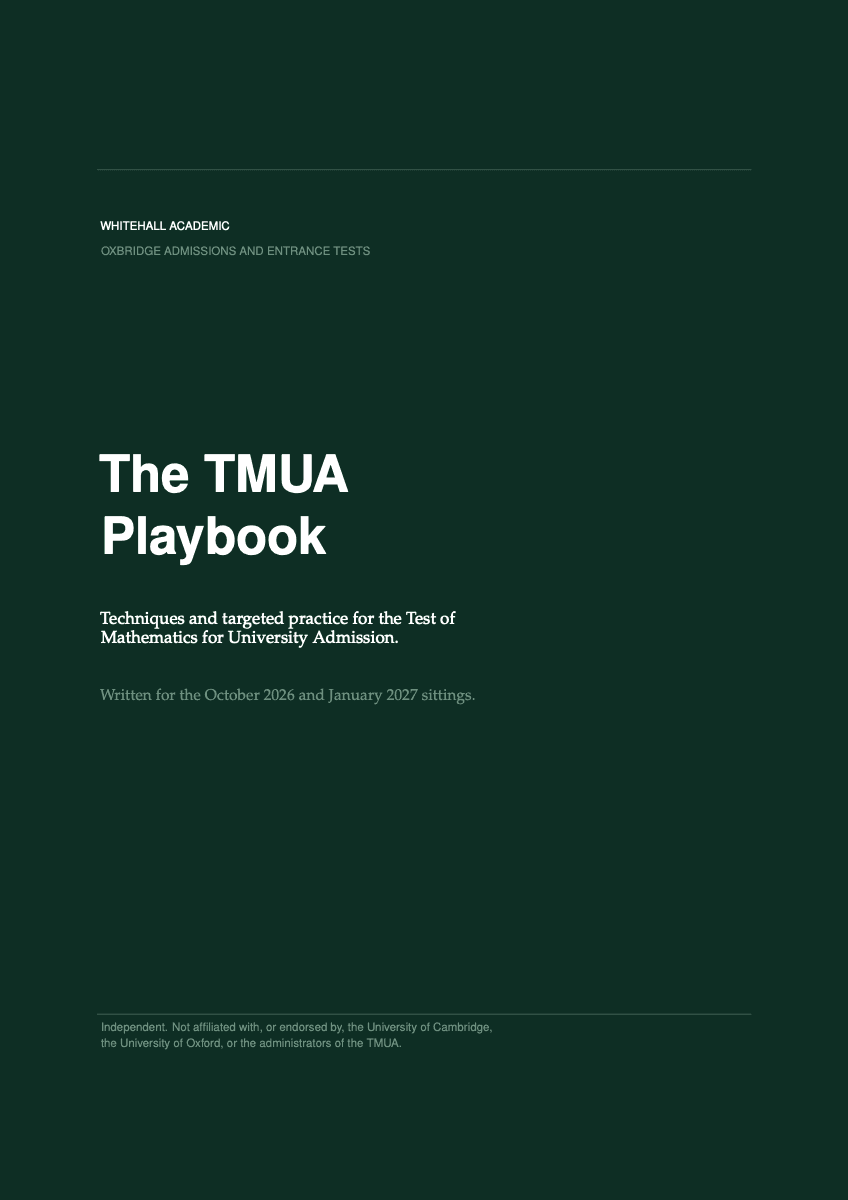
The TMUA Playbook
Our 60-page guide to the TMUA's hardest questions, written for the October 2026 and January 2027 sittings: techniques for both papers, sixteen worked examples and a set of original practice questions with full solutions.
More free guides
Other sections
University applications
How the UK university application process works for 2027 entry: choosing a course, UCAS, the personal statement, references, admissions tests and deadlines.
Oxford and Cambridge
How Oxford and Cambridge admissions work for 2027 entry: the October deadline, admissions tests, written work, interviews, colleges and decision dates.
Not ready yet?
Read a free sample first
A nine-page sample of The TMUA Playbook, sent straight to your inbox. No charge, and you can unsubscribe at any time.