TMUA
How to prepare for the TMUA
The TMUA tests mathematics you have mostly already met, under conditions you mostly haven't: no calculator, multiple choice, a strict clock and a whole paper on logic and proof. Preparation is mainly about closing that gap. This guide covers where to start, what the test rewards and how to use practice well.
Book the test first
Before any preparation, make sure you are registered. Booking for the October sitting closes on 28 September 2026, and there are no late bookings. See TMUA dates and registration.
What the test rewards
Successful TMUA preparation needs familiarity with the mathematics the test covers, practice at solving problems against the clock, and careful review of your mistakes. More specifically, the test rewards:
- Secure knowledge of the specification, mostly GCSE and AS-level pure mathematics, recalled quickly and without a calculator.
- Finding a way into unfamiliar problems. Questions rarely tell you which method to use, and may combine topics you have always met separately.
- Reasoning about mathematical statements, which Paper 2 tests directly.
- Accuracy. Only the answer you select counts, so a correct method with one slip earns nothing.
- Managing time, with 75 minutes for 20 questions in each paper.
Many strong mathematicians find the TMUA harder than they expect. Usually that isn't because the content is harder than school mathematics. It is because school questions tell you what to do, and TMUA questions don't.
Start with the official materials
UAT-UK publishes three things every candidate should use:
- The content specification. Read it early and check each topic against what you have studied. Anything you haven't met, or have forgotten, goes on your list.
- The notes on logic and proof, which set out the logic that Paper 2 assumes. Many schools don't teach it directly.
- Practice materials, including a practice test to take under timed conditions.
They are all on the UAT-UK TMUA page (opens in a new tab). Official material is the only reliable guide to the style and difficulty of real questions, and there is a limited amount of it, so use it thoughtfully.
When to start
There is no single right answer, but most candidates benefit from spreading preparation over several months rather than a few weeks. Start earlier if the specification includes topics you haven't yet covered at school, or if the logic in Paper 2 is new to you. Before planning, take a first look at a practice paper without preparing: seeing where you are now tells you how much there is to do.
Practise under real conditions
- No calculator, ever. If you rely on one in practice, arithmetic will cost you time on the day.
- Time yourself. Twenty questions in 75 minutes averages under four minutes each, and some questions take far longer than others.
- Get used to the screen. The real test is on a computer, with your working done separately. Practise at least some papers that way.
- Keep full official papers for later. Once you have seen a paper, you can't take it fresh again, so save complete papers for measuring your progress under timed conditions.
Review every mistake
Doing more questions helps less than understanding the ones you got wrong. For each mistake, work out why it happened: a gap in knowledge, a misread question, a slip in working, or running out of time. Each has a different fix, and the pattern across many mistakes tells you where your preparation should go.
Give Paper 2 its own preparation
Paper 2 deserves separate attention. It relies on the precise language of logic: "if" and "only if", "necessary" and "sufficient", negation, counterexamples, and what makes a proof valid. School mathematics uses these words all the time but rarely examines them, and Paper 2 questions are written to catch loose thinking about them. Start with UAT-UK's notes on logic and proof, then practise Paper 2 questions as a skill in their own right.
The free sample of The TMUA Playbook includes its chapter on necessary and sufficient conditions, one of the ideas Paper 2 relies on most.
Common preparation mistakes
- Starting in the last week or two, when there is no time left to fix what practice reveals.
- Working through past papers without reviewing mistakes.
- Using up all the official papers early, leaving nothing to measure progress with.
- Treating Paper 2 as an afterthought.
- Practising with a calculator, or without a clock.
- Missing the booking deadline.
Official sources
Dates, requirements and rules on this page come from these official sources, checked on . They change from year to year, so confirm anything you rely on against them. Boxes labelled “Our advice” are Whitehall Academic’s own view.
About the author
Gautam Natarajan founded Whitehall Academic and studies Economics at Trinity College, Cambridge. Gautam has tutored applicants for Oxford and Cambridge from countries including India, China, South Korea and Singapore.
Published . Last updated . Whitehall Academic is independent, and is not affiliated with or endorsed by the University of Oxford, the University of Cambridge, UCAS or UAT-UK.
Going further
The TMUA Playbook
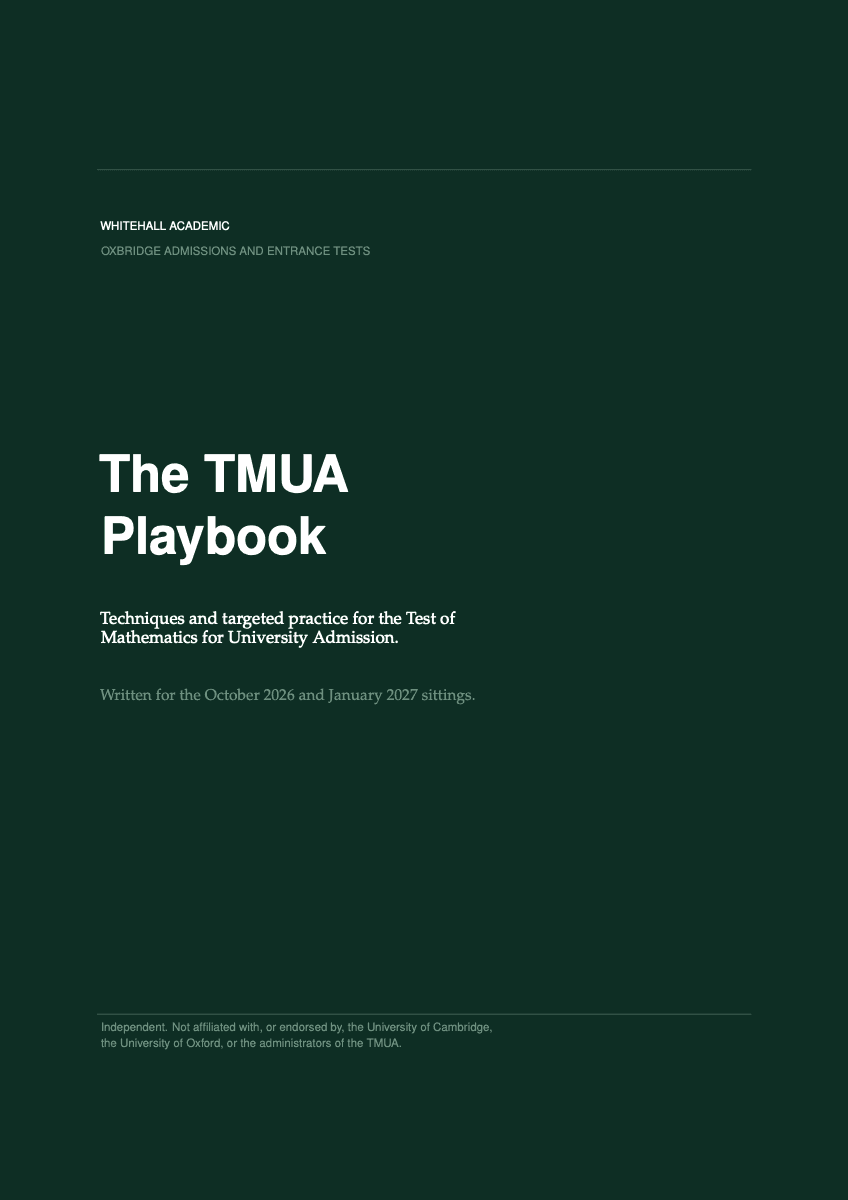
This guide covers what good preparation involves. The TMUA Playbook is the detailed version: techniques for the hardest questions in both papers, sixteen worked examples, a preparation schedule and a set of original practice questions with full solutions.
Keep reading
Related guides
TMUA
What the TMUA is, who needs it, how the two papers work, how it is scored, when to sit it for 2027 entry, and how universities use the results.
TMUA dates and registration
TMUA dates for 2027 entry: booking closes 28 September 2026, and the test is on 15 or 16 October 2026 or 8 January 2027. Fees, bursaries and results.
MAT to TMUA
Oxford has replaced the MAT with the TMUA for Maths, Computer Science and joint courses from 2027 entry. What changed and what it means for applicants.
Not ready yet?
Read a free sample first
A nine-page sample of The TMUA Playbook, sent straight to your inbox. No charge, and you can unsubscribe at any time.