Oxford and Cambridge
How to apply to Oxford
Applying to the University of Oxford for 2027 entry, step by step: choosing a course, entry requirements, admissions tests, colleges, written work, interviews and decisions.
At a glance
- UCAS deadline
- 15 October 2026, 6pm UK time
- Typical A-level offers
- AAA to A*A*A, depending on the course
- Admissions tests
- ESAT, TMUA or TARA for some courses; LNAT for Law; UCAT for Medicine
- Written work
- Some courses, by 10 November 2026
- Interviews
- Online, in December 2026
- Decisions
- 12 January 2027
Step 1: Choose your course
Everything else follows from the course: its entry requirements, whether it has an admissions test or written work, and who will read your application. Oxford offers a number of joint courses that are unusual elsewhere, such as Philosophy, Politics and Economics (PPE), Mathematics and Philosophy, and History and Economics, so compare the full course descriptions rather than the titles. See how to choose a university course, and if you are also considering Cambridge, Oxford vs Cambridge.
Each course page on Oxford's admissions website sets out its requirements and its selection criteria: what the tutors are looking for when they assess applications. Read them for your course before anything else.
Step 2: Check the entry requirements
Oxford's typical A-level offers range from AAA to A*A*A depending on the course, and International Baccalaureate offers from 38 to 40 points including core points, with specified scores at Higher Level. Many courses also require or recommend particular subjects, and international applicants need to meet an English language requirement unless they qualify for an exemption. The details are in Oxford and Cambridge entry requirements.
Step 3: Book an admissions test, if your course needs one
For 2027 entry Oxford uses tests run by UAT-UK, having retired its own tests, including the MAT, PAT and TSA, in January 2026:
- TMUA for Mathematics, Computer Science and their joint courses.
- ESAT for Engineering, Physics, Physics and Philosophy, and Biomedical Sciences.
- TARA for courses including PPE, Economics and Management, History and Economics, Experimental Psychology and Human Sciences.
- LNAT for Law, and UCAT for Medicine, on their own timetables.
Booking for the ESAT, TMUA and TARA closes on 28 September 2026, and Oxford applicants must sit them in the October window, 12 to 16 October 2026. The full course-by-course list is in Oxford and Cambridge admissions tests. If you were expecting to sit the MAT, see the MAT to TMUA switch.
Step 4: Choose a college, or make an open application
You can name one college on your application, or make an open application, in which case a college is allocated to you. You choose a college using its code in the UCAS form. Oxford says that neither choice affects your chances: applications are reallocated between colleges during shortlisting to balance the numbers, and you may be interviewed by more than one college.
College pages are the only reliable source on accommodation, costs, bursaries and which tutors teach your subject there. Check that your course is offered at the colleges you are considering, because not every college takes every subject.
Step 5: Submit your UCAS application
The deadline is 15 October 2026, 6pm UK time, and your school's internal deadline will be earlier. Oxford sees the same personal statement and reference as your other four choices. See how UCAS works and the personal statement explained.
Step 6: Send written work, if your course asks for it
Some courses, mostly in the humanities, ask for one or more pieces of marked school work, to be sent to your college by 10 November 2026. How many pieces, how long and on what topics is set course by course, so take the requirements from your course page.
Step 7: Shortlisting and interviews
Tutors shortlist applicants for interview using everything in the application: grades and predictions, the test score, the personal statement and reference, any written work, and contextual information. You will hear whether you have been shortlisted between mid-November and early December.
For 2027 entry, Oxford's interviews are held online in December 2026. They are conducted by academics in your subject, and Oxford publishes guidance on what to expect on its interviews page, including practical arrangements and sample questions. Interview preparation is covered in The Oxbridge Blueprint rather than here.
Step 8: Decisions
Oxford releases decisions to shortlisted applicants on 12 January 2027, through UCAS, and colleges follow up directly. Offers for applicants still taking their exams are conditional on their results. Applicants who aren't shortlisted find out at the shortlisting stage, when invitations to interview go out.
Support and access programmes
Oxford runs programmes for UK students from under-represented backgrounds, including the UNIQ (opens in a new tab) summer programme for Year 12 students at state schools, and takes contextual information into account when assessing applications. Its admissions pages explain what is available and who is eligible.
Costs
Tuition fees depend on your fee status and course, and living costs vary between colleges. Oxford offers bursaries to UK students from lower-income households. Take current figures from Oxford's fees and funding pages, and if you would pay international fees, work out the full cost of the degree before you apply.
Official sources
Dates, requirements and rules on this page come from these official sources, checked on . They change from year to year, so confirm anything you rely on against them. Boxes labelled “Our advice” are Whitehall Academic’s own view.
- University of Oxford: Undergraduate admissions (opens in a new tab)
- University of Oxford: Admissions timeline (opens in a new tab)
- University of Oxford: Admissions tests (opens in a new tab)
- University of Oxford: Interviews (opens in a new tab)
- University of Oxford: Admission requirements for 2027 entry (opens in a new tab)
- UAT-UK: Course List, 2027 Entry (PDF, updated April 2026) (opens in a new tab)
- UAT-UK: Key dates and deadlines (opens in a new tab)
About the author
Gautam Natarajan founded Whitehall Academic and studies Economics at Trinity College, Cambridge. Gautam has tutored applicants for Oxford and Cambridge from countries including India, China, South Korea and Singapore.
Published . Last updated . Whitehall Academic is independent, and is not affiliated with or endorsed by the University of Oxford, the University of Cambridge, UCAS or UAT-UK.
Going further
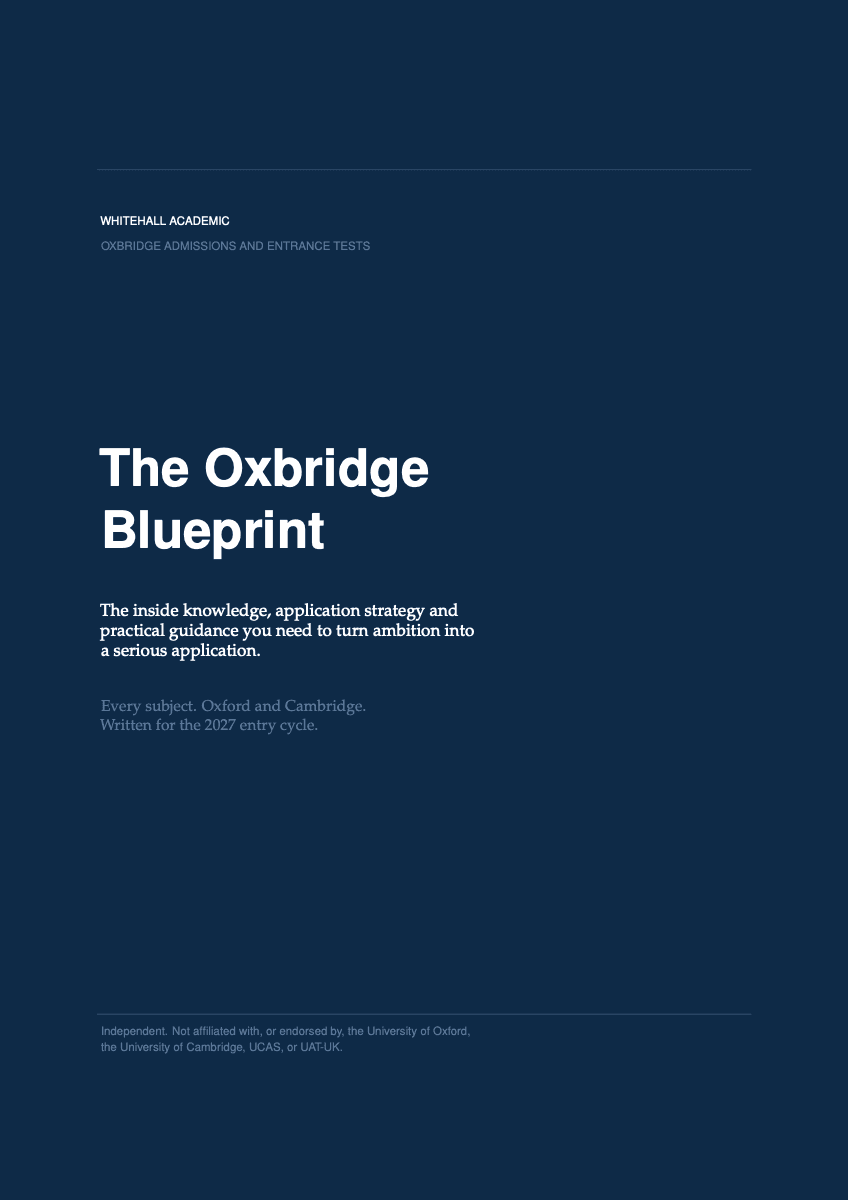
The Oxbridge Blueprint
This guide covers what Oxford asks for and when. The Oxbridge Blueprint covers how to prepare for each stage, from choosing a course and college to written work and interviews, for 2027 entry.
Keep reading
Related guides
Oxford vs Cambridge
Oxford or Cambridge? A factual comparison for 2027 entry: courses, entry requirements, admissions tests, interviews, teaching and decision dates.
Oxbridge admissions tests
Which Oxford and Cambridge courses need an admissions test for 2027 entry: the ESAT, TMUA, TARA, LNAT and UCAT, with ESAT modules and booking dates.
Oxbridge timeline 2027
Every key date for Oxford and Cambridge applications for 2027 entry: test booking, the 15 October deadline, written work, interviews and decisions.