Oxford and Cambridge
How to apply to Cambridge
Applying to the University of Cambridge for 2027 entry, step by step: choosing a course, entry requirements, admissions tests, colleges, My Cambridge Application, interviews and decisions.
At a glance
- UCAS deadline
- 15 October 2026, 6pm UK time
- My Cambridge Application
- 22 October 2026, 6pm UK time
- Typical A-level offers
- A*A*A for most sciences and Economics; A*AA for most other courses
- Admissions tests
- ESAT or TMUA for some courses; LNAT for Law; UCAT for Medicine
- Interviews
- December 2026, online or in person depending on the college
- Decisions
- 27 January 2027
Step 1: Choose your course
Cambridge's courses (called Triposes) are often broader in their first years than the equivalent elsewhere. Natural Sciences, for example, covers a range of sciences before you specialise, and Physics is studied within it rather than as a separate course. Other Cambridge courses have no direct Oxford equivalent, such as Land Economy, Human, Social, and Political Sciences, and Veterinary Medicine. Read the full course outline, year by year, on Cambridge's course pages. See also Oxford vs Cambridge.
Step 2: Check the entry requirements
Cambridge's typical A-level offer is A*A*A for most science courses and Economics, and A*AA for most other courses. International Baccalaureate offers are typically 40 to 42 points including core points, with 776 at Higher Level. Many courses require or recommend particular subjects, and international applicants need to meet an English language requirement unless exempt. The details are in Oxford and Cambridge entry requirements.
Step 3: Book an admissions test, if your course needs one
- TMUA for Computer Science, Economics and Mathematics.
- ESAT for Engineering, Chemical Engineering and Biotechnology, Natural Sciences and Veterinary Medicine.
- LNAT for Law, and UCAT for Medicine, on their own timetables.
Booking for the ESAT and TMUA closes on 28 September 2026, and Cambridge applicants must sit them in the October window, 12 to 16 October 2026. Some colleges also set their own written assessment at interview for particular courses; your college will tell you if so. Mathematics offers usually include grades in STEP, sat in June. See Oxford and Cambridge admissions tests for module requirements and the full list.
Step 4: Choose a college, or make an open application
You can name a college on your application or make an open application, in which case a college is allocated to you. Colleges differ in size, location, accommodation, facilities and financial support, and a few admit only students aged 21 or over or have other particular admissions criteria. Take all of this from the colleges' own websites.
Through the Winter Pool, colleges can offer places to strong applicants who applied to a different college, so naming a popular college doesn't cost a strong applicant their chance.
Step 5: Submit your UCAS application
The deadline is 15 October 2026, 6pm UK time. Cambridge sees the same personal statement and reference as your other choices. See how UCAS works and the personal statement explained.
Step 6: Complete My Cambridge Application
After submitting through UCAS, most applicants complete My Cambridge Application, an online form that Cambridge sends you a link to. The deadline is 22 October 2026, 6pm UK time. It asks for further information about you and your studies, and includes an optional Cambridge-specific statement.
Step 7: Written work, if your course or college asks for it
Some courses and colleges ask for examples of written work, usually school essays, in the autumn. Your college will tell you what is needed and by when.
Step 8: Interviews
Cambridge interviews a large proportion of its applicants. Most interviews take place in the first three weeks of December, and whether yours is online or in person depends on your college and course. Interviews are conducted by academics in your subject. Cambridge's admissions website explains what they involve; preparation is covered in The Oxbridge Blueprint rather than here.
Step 9: The Winter Pool and decisions
In January, applicants whom a college rates highly but can't offer a place to can be placed in the Winter Pool, where other colleges can consider them, sometimes with a further interview. Decisions for applicants who were interviewed are released on 27 January 2027: colleges email in the morning, and the outcome appears in the UCAS Hub by mid-afternoon. Offers for applicants still taking exams are conditional on their results.
Support, access and costs
Cambridge takes the context of your education into account, runs access programmes for UK students from under-represented backgrounds, and offers bursaries to UK students from lower-income households. Tuition fees depend on your fee status and course, and living costs vary between colleges. Take current figures from the university's and colleges' own pages.
Official sources
Dates, requirements and rules on this page come from these official sources, checked on . They change from year to year, so confirm anything you rely on against them. Boxes labelled “Our advice” are Whitehall Academic’s own view.
- University of Cambridge: Applying (opens in a new tab)
- University of Cambridge: Application dates and deadlines (opens in a new tab)
- University of Cambridge: Completing My Cambridge Application (opens in a new tab)
- University of Cambridge: Outcome of your application (opens in a new tab)
- University of Cambridge: Entry requirements (opens in a new tab)
- University of Cambridge: Courses for 2027 entry (opens in a new tab)
- UAT-UK: Course List, 2027 Entry (PDF, updated April 2026) (opens in a new tab)
- UAT-UK: Key dates and deadlines (opens in a new tab)
About the author
Gautam Natarajan founded Whitehall Academic and studies Economics at Trinity College, Cambridge. Gautam has tutored applicants for Oxford and Cambridge from countries including India, China, South Korea and Singapore.
Published . Last updated . Whitehall Academic is independent, and is not affiliated with or endorsed by the University of Oxford, the University of Cambridge, UCAS or UAT-UK.
Going further
The Oxbridge Blueprint
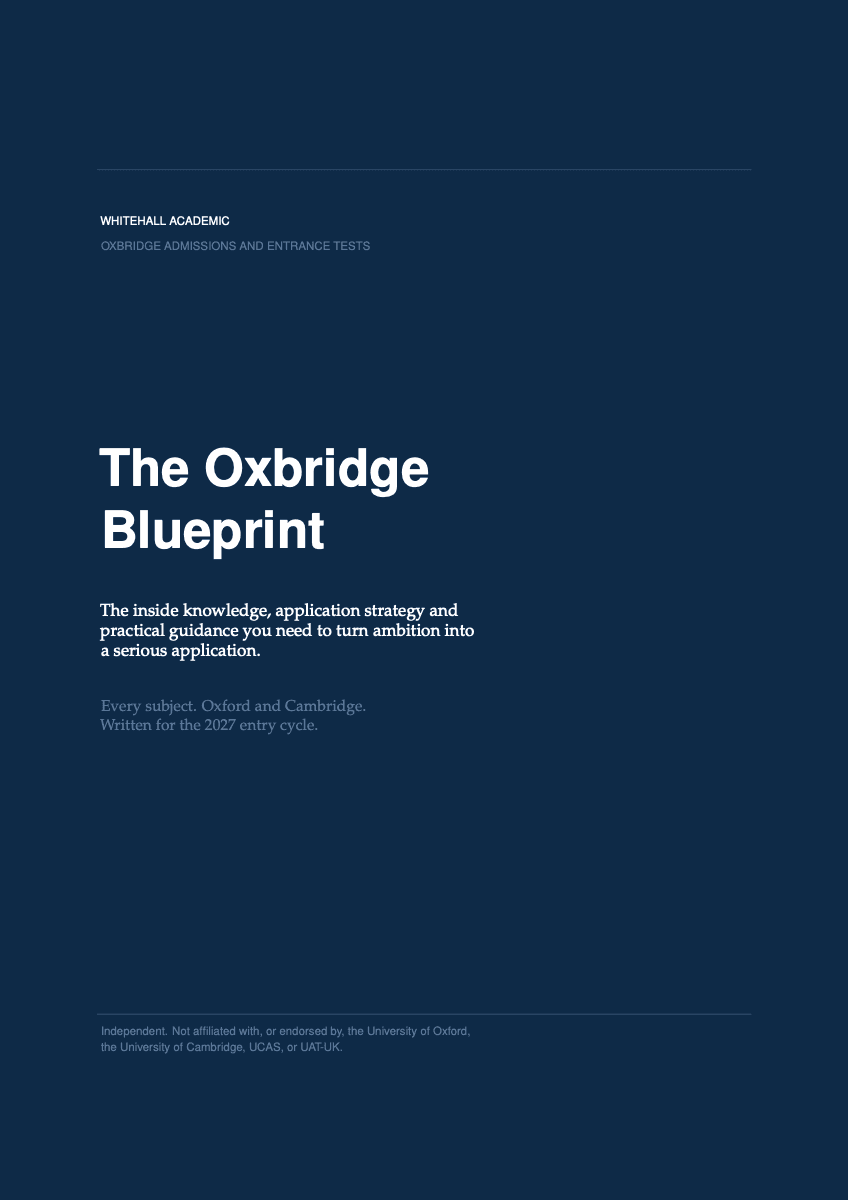
This guide covers what Cambridge asks for and when. The Oxbridge Blueprint covers how to prepare for each stage, from choosing a course and college to the written application and interviews, for 2027 entry.
Keep reading
Related guides
Oxford vs Cambridge
Oxford or Cambridge? A factual comparison for 2027 entry: courses, entry requirements, admissions tests, interviews, teaching and decision dates.
Oxbridge admissions tests
Which Oxford and Cambridge courses need an admissions test for 2027 entry: the ESAT, TMUA, TARA, LNAT and UCAT, with ESAT modules and booking dates.
Oxbridge timeline 2027
Every key date for Oxford and Cambridge applications for 2027 entry: test booking, the 15 October deadline, written work, interviews and decisions.